
How to Search Criminal Dockets
Start with Kansas CaseSearch, the main district-court portal. Set Court to District, pick Seward County, and choose Criminal under the extra filters. You can search by exact case number, party name, business name, party-as-business name, or citation number. The portal sometimes asks for a human check. That blocks bots. It does not mean the record is missing.
When comparing matches, keep the case number, filing year, court, and party role in view. Common names pull up unrelated cases. Filing-date filters narrow the register but do not search by hearing date. There is also an optional birth-date field. Use it only to tell similar records apart, and never copy a full birth date into public notes.
- Choose District court and Seward County.
- Select Criminal and the most exact search type.
- Complete the human check and compare case details.
- Read the events index from oldest to newest.
- Confirm an unclear result through the clerk or terminal.
Seward Criminal Search Fallbacks
The internet is not the only door. Kansas Supreme Court Rule 22 requires every district court to keep a public terminal. In Seward County, that terminal sits with the District Court clerk. The address is 415 N. Washington, Suite 103, Liberal. Counter hours are weekdays 8 a.m. to noon and 1 p.m. to 5 p.m. The main number is (620) 626-3375. Records or events kept off the web portal may still appear there.
You can also mail a case-specific request on the Kansas Judicial Branch court-record request form. It offers delivery by mail, email, pickup, or fax. The Seward directory publishes no clerk email, though. Two official pages disagree on the fax number. Call first. Here is one caution. The County Clerk's web KORA form handles county administrative records. It does not cover District Court criminal files.
What a Criminal Docket Shows
Kansas names its chronological summary a register of action. CaseSearch may call it case information, case events, or events index. Whatever the label, it is a dated index rather than the full official file. A complaint, order, or journal entry can be listed. No image may be available on the public web.
| Case number | Older matters may use YYYY-CR-######; newer matters use a county prefix such as SW-YYYY-CR-######. |
|---|---|
| Header | Court, county, type, filing date, status, and assigned judge when public. |
| Parties | Public roles and attorneys, with protected identities withheld. |
| Events | Charges, appearances, motions, settings, orders, pleas, and appeals. |
| Disposition | The outcome entry, followed when needed by the signed judgment. |
Trust the exact number the portal or clerk prints. A CR segment hints at a criminal case, but the case type shown in the record is what controls.
Seward Criminal Number Changes
Seward County moved onto the statewide eCourt system on September 12, 2022. Cases opened before that date carry the older pattern of year, type, and a six-digit sequence. Newer numbers add a two-letter county prefix. This matters when an old notice or attorney file lacks the prefix the search screen now expects.
Enter the number exactly as printed first. If nothing comes back, search by party name. Narrow to Seward County, Criminal, and the likely filing window. Do not guess missing digits. A clerk can tell whether an older number belongs to a paper, archive, or converted file.
Stages on a Criminal Docket
A criminal register usually opens with a complaint, information, indictment, or another charging event. From there it may list first appearance, arraignment, counsel, plea, bond, preliminary hearing, discovery, motions, and pretrial settings. Each line stays brief. Probable-cause material, an unreturned warrant, or another protected attachment may stay offline. The related event can still be visible.
Docket flow: Filing › First Appearance › Arraignment › Pretrial › Plea or Trial › Disposition › Sentencing
Later entries can cover restitution, costs, probation, community corrections, revocation, appeal, transcript, or mandate. A reset is not a dismissal. Local Rule 118 requires written continuance requests. The approved order or new setting controls. Presentence reports stay outside public portal access even when the register shows a sentencing date.
Seward Criminal Terms in Context
Disposition words deserve care. Diversion or deferred adjudication points to a program or deferred path. That is not an automatic conviction or dismissal. A dismissal closes the charge as the entry states. The reason may sit in the order itself. A guilty plea can bring sentencing that same day or later. The journal entry is the signed court paper that gives an action legal effect.
- Continuance
- A setting moved by court action.
- Disposition
- The recorded outcome or closing event.
- Mandate
- The appellate court’s formal return of authority.
- Restricted
- An access status, not proof that no case exists.
When the precise result matters, read the final entry beside the signed order. A short portal line can leave out conditions, charge-level differences, and the reason for a ruling.
Seward Criminal Docket Scale
Official FY2025 statistics add scale without describing anyone. Seward County logged 337 felony filings, 31 misdemeanor filings, and four appeals. The pending snapshot showed 204 felony cases, 23.0 percent older than twelve months, plus 13 misdemeanor cases, 53.8 percent older than twelve months. Filings count court activity, not people, arrests, or convictions.
The disposition report separately lists 397 felony dispositions and 72 misdemeanor dispositions spread across diversion, dismissal, plea, other, and trial categories. Those totals cannot predict the result of any single case.
Which Court Holds Criminal Dockets
Felonies and other Kansas-law prosecutions in Seward County sit in District Court. That court belongs to the 26th Judicial District. State or highway citations can land there too. The clerk at the Liberal courthouse keeps that criminal docket register. District traffic questions run through a separate line at (620) 626-3232.
Municipal cases are a different office entirely. Liberal Municipal Court handles city ordinance, traffic, and misdemeanor cases at 325 N. Washington Avenue. It has its own citation portal and municipal clerk apart from CaseSearch. Kismet reports as a municipal court but offers no online docket search. Call City Hall at (620) 563-9503. Federal charges belong to the U.S. District Court for the District of Kansas instead.
Seward and Federal Dockets Differ
For a look at the federal side, the official District of Kansas CM/ECF court-information screen displays that separate federal filing environment.
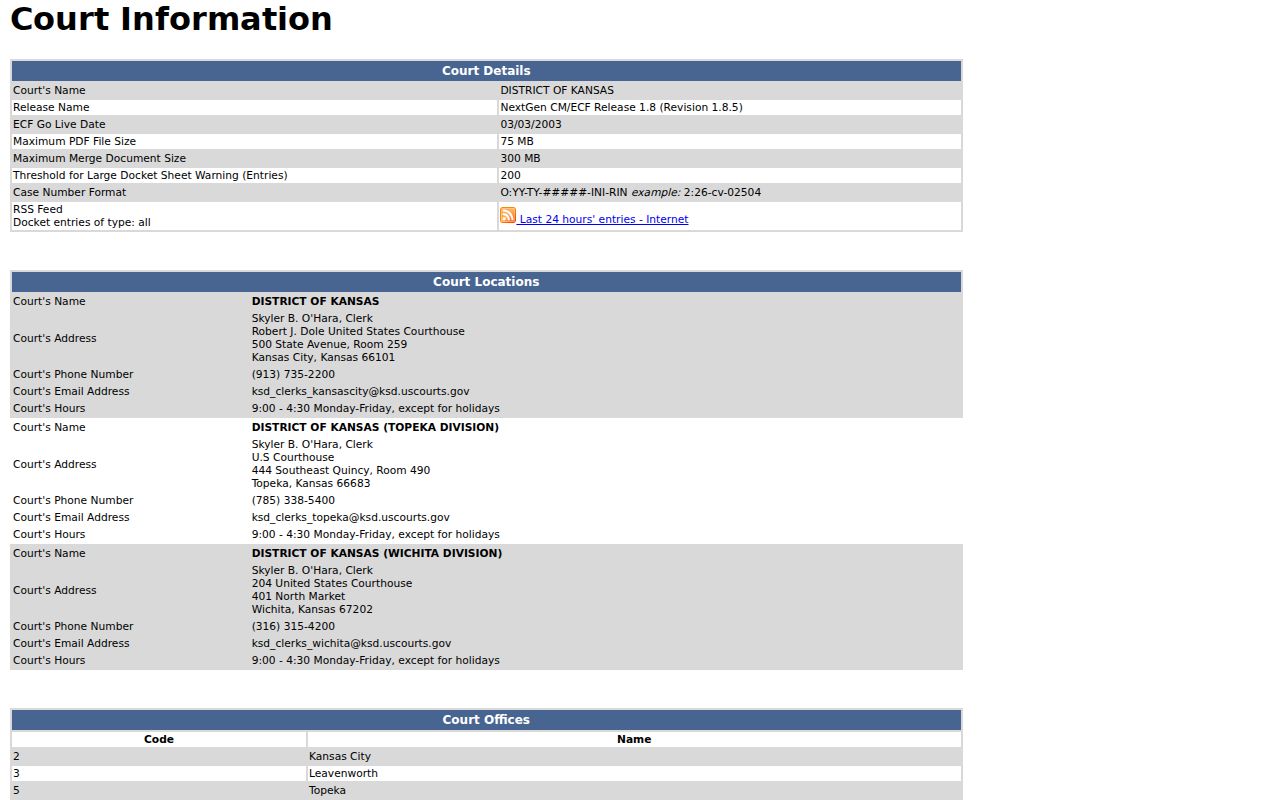
That screen draws a firm line. Federal docket numbers and CM/ECF entries never appear in Kansas CaseSearch. Public federal records live in PACER, while Seward County state cases stay with the District Court register and clerk.
Seward Criminal Record Copies
To order a filed paper, know the court, the case number, the document name, and whether you want a plain or certified copy. Kansas publishes no Seward-specific district fee or turnaround. K.S.A. 45-219 allows charging reasonable actual costs, paid in advance. So ask the clerk for an estimate, certification terms, postage, and a completion date before you commit.
Transcripts take another path. The district directory lists a transcriptionist at (620) 626-3235, and local Rule 113 requires a written request to the presiding judge before any work routes to the reporter or transcriptionist. A portal printout counts as neither a certified court record nor a transcript.
Seward Criminal Appeals Change Courts
Appeals start by changing courts. A Liberal Municipal Court appeal moves first to Seward County District Court, but a District Court judgment appeals instead to the Kansas Court of Appeals or the Kansas Supreme Court. When you read a docket, look for the notice of appeal and the later mandate in the proper register. The appellate filings relate to the trial case. Still, they form a distinct court layer with their own docket entries.
Public Access and Sealed Criminal Dockets
A portal miss can mean two things. The record may sit at a public terminal only. Or a statute, rule, or order may make the case nonpublic. Rule 22 keeps expunged cases, grand-jury matters, juvenile matters, protection proceedings, presentence investigations, some warrant material, and other sensitive records off the internet. Sealed material is unavailable at both the portal and the terminal.
Key access rules
Kansas Supreme Court Rule 22 creates portal and terminal channels while limiting online categories.
Kansas Supreme Court Rule 24 protects listed personal identifiers.
K.S.A. 45-218 governs inspection, response timing, and written denial grounds.
When access is unclear, ask whether the item is public, terminal-only, or restricted. If you are denied, request the supporting rule, statute, or order and ask whether a redacted register of the court docket can be released.